

AT A GLANCE
In the Nigerian maritime and offshore logistics sector, Automotive Gas Oil (AGO / Marine Diesel) represents between 60% and 75% of a vessel’s total operating expenditure (OPEX). Following national fuel subsidy reforms, volatile currency valuations, and escalating bunkering costs, even a 5% margin of unmonitored fuel burn or unauthorized diversion can wipe out an operator’s entire operating profit. Traditional dip-tape soundings, manual engine logs, and daily noon reports sent over WhatsApp are fundamentally incapable of stopping sophisticated fuel theft or detecting engine inefficiencies. Deploying automated vessel fuel monitoring solutions, combining high-precision Coriolis mass flow meters, tamper-proof edge telemetry, and intelligent cloud analytics, gives Nigerian shipowners 100% real-time visibility, eradicates bunker siphoning, and delivers a full capital return on investment within 3 to 6 months.
Introduction: The High Stakes of Marine Fuel (AGO) in Nigeria
If you operate commercial vessels in Nigeria today, you do not need an accountant to tell you where the majority of your cash flow goes. Marine Gas Oil (AGO) is, by a wide margin, your single largest operational cost.
Over the past several years, the cost of AGO in Nigeria has surged dramatically, frequently trading between ₦1,200 and ₦1,650+ per liter depending on port location, offshore delivery surcharges, and global crude benchmarks. For an offshore support vessel burning between 2,500 and 6,000 liters of diesel per day, monthly fuel expenditures easily run into tens of millions of Naira per vessel.
At these price levels, unmonitored fuel is literally burning away your bottom line. Yet, across the anchorages of Lagos, the waterways of Warri, the Bonny River, and offshore deepwater concessions, many Nigerian shipowners still rely on methods developed in the 19th century to monitor their most valuable asset: manual sounding tapes and handwritten noon reports.
The result? Unexplained fuel variances, systemic bunker siphoning, frequent disputes with charterers over claimed consumption, and engines operating at sub-optimal fuel burn rates. To build a profitable, resilient maritime business in Nigeria, manual guesswork must be replaced with automated, verifiable fuel intelligence.
The Anatomy of Bunker Loss in Nigerian Waters: How Fuel Disappears
Fuel loss in the Nigerian maritime domain is rarely caused by simple engine wear. It is driven by systemic operational vulnerabilities that thrive when there is zero real-time visibility. Understanding these mechanisms is the first step toward stopping them:
A. The ‘Cappuccino Effect’ During Offshore Bunkering
The ‘cappuccino effect’ is one of the most widespread and lucrative bunkering scams in West Africa. When a bunker barge delivers AGO to your vessel at an offshore anchorage or mid-stream transfer point, the supplier introduces compressed air into the fuel delivery lines. This aerates the fuel, creating a thick, frothy mixture resembling cappuccino foam.
- The Illusion of Volume: When your Chief Engineer takes manual dip soundings or reads standard volumetric meters immediately following the bunkering operation, the fuel volume appears to match the Bunker Delivery Note (BDN).
- The Inevitable Shrinkage: Twelve to twenty-four hours later, the micro-air bubbles dissolve and vent out through the tank air pipes. The fuel level drops significantly, sometimes by 5% to 12% of the total bunkered quantity. By then, the bunker barge has departed, the delivery receipt is signed, and your company has absorbed a multi-million Naira loss.
B. Midnight Siphoning and Unauthorized At-Sea Discharges
Vessels spending extended periods drifting or waiting at anchor, such as the Lagos Offshore Anchorage (LOA), Escravos Fairway, or Bonny Offshore Anchorage, are prime targets for unauthorized fuel diversion. In collusion with rogue crew members, unauthorized coastal craft (such as wooden Cotonou boats or unmanifested service barges) pull alongside during night hours to siphon fuel directly from service or storage tanks. Without automated sensors, this loss is simply recorded in the engine logbook as ‘heavy auxiliary consumption’ or ‘adverse sea state burn.’
C. ‘Magic Pencil’ Manual Noon Reports
In traditional operations, the Chief Engineer records daily fuel consumption on a paper log, calculates the remaining fuel on board (ROB), and emails or whatsapps a daily ‘Noon Report’ to the Lagos technical superintendent. In reality, these numbers are frequently ‘balanced’ by hand to match expected charter party consumption curves rather than actual physical burn. True mechanical defects, such as worn fuel injectors, slipping turbochargers, or hull fouling, remain completely hidden until catastrophic engine failure occurs.
What is a Modern Marine Fuel Management System?
A modern marine fuel management system is an end-to-end, IoT-enabled technology architecture designed to capture, secure, transmit, and analyze fuel flow data across every engine and generator on board a vessel without human intervention.
The system operates across three interconnected technological layers:
- 1. Physical Sensor Layer (Engine Room): High-precision physical flow meters installed directly on the supply and return fuel lines of the main propulsion engines and auxiliary diesel generators.
- 2. Edge Processing & Telemetry Layer: An industrial, tamper-evident edge-computing data logger mounted in the Engine Control Room (ECR) that continuously reads sensor pulses, calculates differential fuel mass, and encrypts the records.
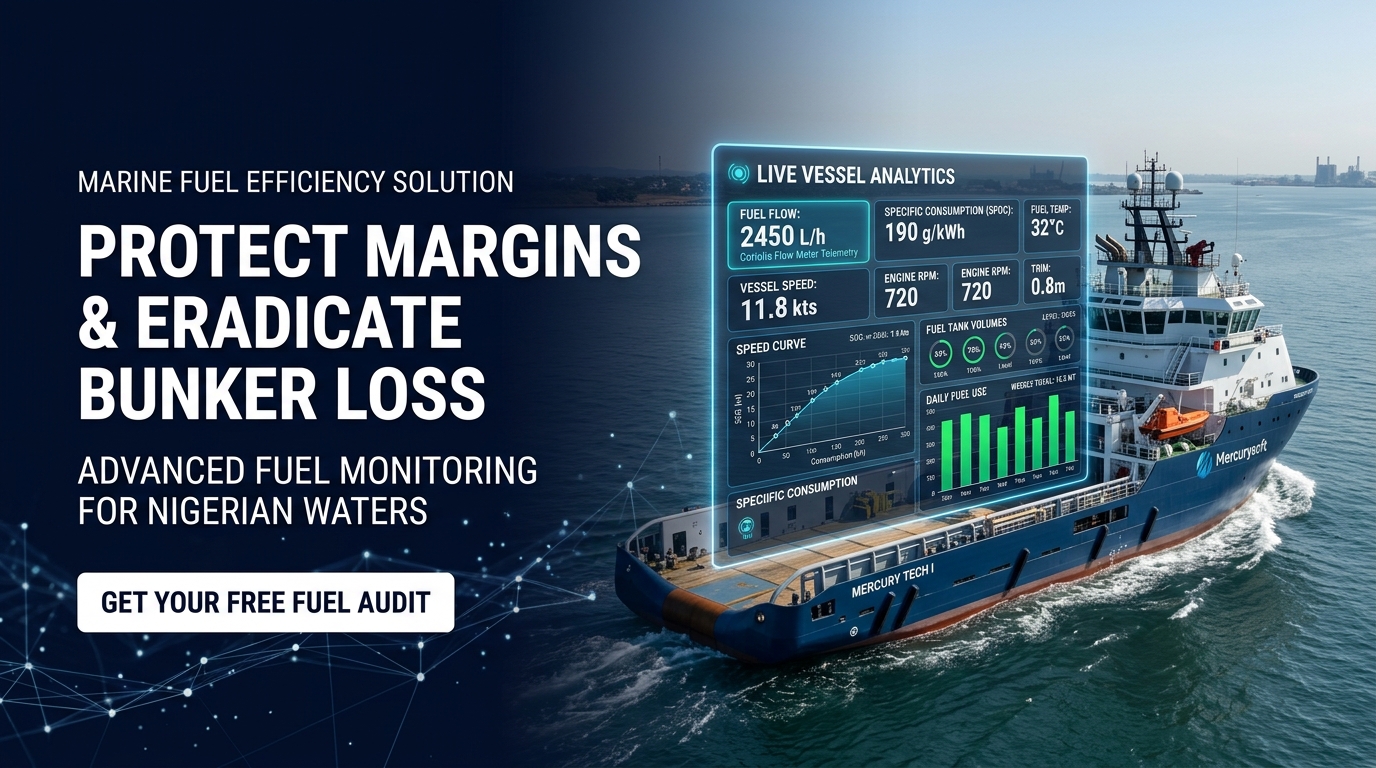
- 3. Cloud Intelligence & Analytics Layer: A secure web-based software dashboard accessed by technical directors and vessel superintendents in Lagos or Port Harcourt, displaying live fuel burn, vessel speed-through-water, tank volumes, and automated theft alerts.
Hardware Deep-Dive: Why Volumetric Meters Fail and Coriolis Mass Flow Meters Win
When selecting fuel monitoring hardware for Nigerian operations, the choice of meter technology is the single most important decision. Historically, many shipyards installed mechanical positive displacement (PD) or volumetric flow meters. In Nigerian waters, this is a recipe for failure:
| Engineering Feature | Standard Volumetric / PD Meters | Advanced Coriolis Mass Flow Meters |
|---|---|---|
| Measurement Metric | Measures volume (liters or cubic meters) | Measures true mass directly (kilograms / metric tons) |
| Susceptibility to Aeration | Fooled by air bubbles; counts air as fuel | 100% immune to air (‘cappuccino effect’); detects void fraction |
| Temperature Sensitivity | Requires complex manual temperature correction | Built-in temperature & density sensors; auto-compensating |
| Mechanical Durability | Moving gears jam on contaminated fuel or sludge | Zero moving parts; no mechanical wear, zero clogging risk |
| Tamper Resistance | Easily bypassed, pulsed, or mechanically jammed | Digitally locked, internal diagnostic logs flag any tampering |
| Class & Custody Approval | Rarely approved for commercial custody transfer | Recognized gold standard for custody transfer (OIML, Class approved) |
Coriolis mass flow meters operate on the principles of fluid dynamics and inertial motion. As fuel flows through vibrating measuring tubes, the fluid mass causes a phase shift (Coriolis effect) that is directly proportional to the true mass of the fuel. Because mass does not change with temperature, pressure, or aeration, Coriolis meters provide unassailable accuracy (within ±0.1% to ±0.2%), making them the ultimate defense against bunkering disputes and fraud in West Africa.
The Digital Telemetry & Anti-Tamper Security Architecture
Even the most accurate flow meter is useless if the signal wire can be disconnected or manipulated in the engine room. To prevent sabotage and guarantee data integrity, Mercurysoft’s fuel monitoring installations incorporate multi-layered physical and digital security protocols:
- Physical Tamper-Proofing: All sensor wiring runs through armored steel conduits with serialized, tamper-evident mechanical security seals applied to all junction boxes and flange couplings.
- Power-Cut & Signal Loss Logging: The edge data logger continuously monitors power supply continuity and sensor signal health. If an engineer disconnects power to a flow meter, the system instantly triggers an alert and logs the exact timestamp and duration of the power cut.
- Dual-Band GSM/Satellite Telemetry: In coastal waters (within 15-20 nautical miles of the Nigerian coastline, including Lagos port channels, Escravos, and Bonny), the telemetry unit transmits data over encrypted high-speed 4G/LTE networks. When transiting deep offshore to oilfields, the system seamlessly routes telemetry via the ship’s satellite communication system (VSAT, Inmarsat, or Starlink).
- Cryptographic Hash Validation: Raw data is cryptographically hashed at the sensor edge, ensuring that data packets transmitted to the shore cloud cannot be intercepted, altered, or forged.
Real-Time Shore Analytics: What Fleet Managers See in Lagos & Port Harcourt
Installing hardware is only half the battle; the true operational value comes from turning raw sensor data into actionable shore-side decisions. Through Mercurysoft’s cloud interface, technical superintendents gain real-time operational control:
A. Live Differential Burn (Supply vs. Return)
Modern marine diesel engines recirculate a large volume of hot fuel back from the injectors to the service tank. A proper fuel monitoring system measures both the supply line and the return line, calculating the exact net fuel consumed by the engine cylinders in real-time. Superintendents can instantly see whether an auxiliary generator is burning 35 liters per hour or running inefficiently at 52 liters per hour.
B. Specific Fuel Oil Consumption (SFOC) vs. Vessel Speed
By overlaying fuel burn data with GPS speed-over-ground (SOG), speed-through-water (STW), and engine RPM, the system establishes precise baseline efficiency curves for each vessel. If a vessel increases speed from 10 knots to 12 knots but fuel consumption spikes by 45%, shore managers can immediately instruct the Master to trim the vessel or maintain eco-speed, saving thousands of liters per voyage.
C. Automated Theft & Anomaly Alarms
The system’s background algorithms continuously monitor fuel flow rates against vessel operational states:
- Anchorage Drop Alert: If fuel levels in the service or settling tanks drop while the main engines are shut down and the vessel is at anchor, an emergency alert is triggered via SMS and email to the Technical Director within 60 seconds.
- Bunkering Variance Alert: If fuel intake measured during bunkering deviates by more than 1.5% from the quantity declared on the Bunker Delivery Note, the system flags a discrepancy before the bunker barge unhooks its hoses.
Winning Charters: Transforming Fuel Telemetry into Commercial Dominance
Fuel monitoring is not merely a defensive measure against theft; it is an aggressive commercial asset for winning high-value offshore charters. In Nigeria’s competitive offshore energy market, International Oil Companies (IOCs) and NNPCL are demanding greater environmental transparency and cost accountability:
- IOC Charterer Transparency: In time-charter agreements where the charterer pays for fuel, energy majors are wary of operators who submit inflated fuel consumption claims. Providing IOC marine logistics managers with secure, real-time guest dashboard access to live fuel burn data builds immense commercial trust and eliminates contentious billing disputes.
- Automated Carbon & Emissions Reporting: With global maritime decarbonization mandates (IMO DCS, CII, and EU MRV regulations impacting international trade in the Gulf of Guinea), automated mass flow data provides certified, audit-ready emissions reporting with zero manual data entry.
Real-World Financial ROI Modeling for a Nigerian Offshore Fleet
To demonstrate the rapid financial payback of deploying automated fuel monitoring, consider a conservative financial model for a typical Nigerian offshore logistics operator running a fleet of four Offshore Support Vessels (OSVs / AHTS):
| Fleet Operational Parameter | Baseline (Manual / Unmonitored) | With Mercurysoft Fuel Telemetry | Net Operational Savings |
|---|---|---|---|
| Fleet Size & Type | 4 Offshore Support Vessels (OSVs) | 4 Offshore Support Vessels (OSVs) | – |
| Average Daily Fuel Burn per Vessel | 3,500 Liters of AGO / Day | 3,220 Liters of AGO / Day (8% optimization) | 280 Liters Saved / Vessel / Day |
| Total Fleet Daily Consumption | 14,000 Liters / Day | 12,880 Liters / Day | 1,120 Liters Saved / Day |
| Average Cost of AGO in Nigeria | ₦1,350 per Liter | ₦1,350 per Liter | – |
| Total Monthly Fleet Fuel Spend (30 Days) | ₦567,000,000 | ₦521,640,000 | ₦45,360,000 Saved / Month |
| Annualized Fuel Cost Savings | ₦6.804 Billion | ₦6.259 Billion | ₦544,320,000 Saved / Year |
Financial Return on Investment: THE ROI BOTTOM LINE
By achieving a modest 8% reduction in fuel waste, theft, and operational inefficiencies across four vessels, a Nigerian shipowner saves over ₦45 Million every single month. When compared against the total turnkey cost of supplying and installing Coriolis flow meters and telemetry units, the entire capital investment is fully paid back within 3.5 to 5 months of operation. Beyond the payback period, every liter saved flows straight to the company’s net profitability.
Local Installation, Commissioning, and Class Approvals in Nigeria
The biggest barrier that previously stopped Nigerian operators from deploying high-end fuel monitoring was logistics. European and Asian hardware providers required Nigerian companies to pay exorbitant fees to fly foreign marine instrumentation engineers into Lagos, arrange armed security escorts to Port Harcourt, and wait months for visa approvals.
Mercurysoft eliminates this barrier through an entirely localized engineering deployment model:
- Stage 1: Local Pre-Installation Survey: Our Lagos-based marine instrumentation team visits your vessel at any Nigerian terminal, Snake Island Integrated Free Zone (SIIFZ), Nigerdock, Naval Dockyard Victoria Island, Kirikiri, Onne Port, or Warri, to measure pipe runs, verify power availability, and generate detailed piping and instrumentation diagrams (P&ID).
- Stage 2: Local Spool Fabrication: Custom spool pieces and flanges are pre-fabricated in certified local machine shops according to strict classification standards, ensuring that when the vessel arrives at berth, installation requires minimal hot-work time.
- Stage 3: Rapid Turnaround Installation: Our engineers perform mechanical fitting, electrical wiring, telemetry box mounting, and end-to-end signal calibration within a standard 48-to-72 hour port call, eliminating commercial off-hire downtime.
- Stage 4: Class-Certified Commissioning: All installations comply fully with major Classification Society rules (Lloyd’s Register, DNV, Bureau Veritas, ABS) and are certified for safe deployment in marine engine room environments.
Conclusion & Next Steps: Take Full Control of Your Fuel Today
In the fiercely competitive Nigerian maritime landscape, fuel is either your greatest operational liability or your sharpest competitive advantage. Continuing to rely on manual dipsticks and unverified paper noon reports leaves your bottom line vulnerable to theft, fraud, and unoptimized engine performance.
By partnering with Mercurysoft to deploy Coriolis mass flow meters and intelligent cloud fuel telemetry, you safeguard your assets, eliminate bunker diversion, impress top-tier IOC charterers, and preserve millions of Naira in hard-earned operating capital.
Frequently Asked Questions (FAQ) on Marine Fuel Monitoring in Nigeria
Q1: How long does hardware installation take, and will it take our ship off-hire?
A: A typical installation on a two-engine, two-generator vessel takes between 48 and 72 hours. Because our local technical team pre-measures piping and pre-fabricates all spool pieces before your ship arrives at berth, we can complete the installation during a routine port stay or scheduled bunkering window in Lagos, Onne, or Port Harcourt without causing commercial downtime.
Q2: What prevents the onboard crew from sabotaging or bypassing the flow meters?
A: This is the most common concern for Nigerian shipowners. Mercurysoft’s system is engineered defensively: all wiring is protected by armored metal conduit, junction boxes are sealed with numbered tamper-evident wire seals, and the edge telemetry unit logs power drops and sensor disconnects immediately. If a wire is clipped or a sensor bypassed, an alert is transmitted to shore management within 60 seconds with an exact timestamp.
Q3: Will the telemetry data consume significant satellite bandwidth offshore?
A: No. In coastal waters, the telemetry logger utilizes local 4G/LTE cellular networks (MTN and Airtel marine SIMs), incurring negligible cost. In deep offshore waters, our proprietary compression algorithms reduce telemetry data to tiny micro-packets, consuming less than 15 MB of satellite data per month, a tiny fraction of standard VSAT data packages.
Request Your Free Fuel Audit with Mercurysoft
Stop letting your fuel profits disappear into the water. Contact Mercurysoft’s Lagos engineering headquarters today to request a free vessel fuel audit. Our technical team will review your engine room configuration, assess your historical fuel variance, and design a custom, Class-compliant monitoring package that pays for itself in months.