

AT A GLANCE
Operating commercial vessels in Nigerian territorial waters and the Gulf of Guinea requires navigating a distinct mix of rigorous regulatory frameworks (NIMASA, NCDMB, Cabotage Act, and IOC marine vetting), extreme foreign exchange (FX) volatility, offshore connectivity constraints, and severe supply chain bottlenecks at ports. Relying on disconnected Excel spreadsheets and fragmented WhatsApp messages exposes Nigerian vessel owners to catastrophic machinery downtime, punitive port detentions, and disqualified bids for lucrative oil and gas charters. Purpose-built maritime fleet management software provides a centralized, offline-first digital operational backbone that automates planned maintenance (PMS), guarantees seafarer compliance, streamlines spare parts procurement across Lagos and Port Harcourt, and saves millions of Naira in foreign currency expenditures.
Introduction: The Operational Reality of Shipping in Nigerian Waters
Operating maritime assets in Nigeria is unlike running a shipping line in Northern Europe or Southeast Asia. Whether you are managing Offshore Support Vessels (OSVs), Anchor Handling Tug Supply (AHTS) vessels, Platform Supply Vessels (PSVs), Fast Support Intervention Vessels (FSIVs), coastal product tankers, security escort vessels, or push-tugs and barges, your day-to-day operations are dictated by a unique ecosystem:
- Intensive Regulatory Scrutiny: Operating under the multi-layered jurisdiction of NIMASA (Nigerian Maritime Administration and Safety Agency), the Nigerian Ports Authority (NPA), and the Nigerian Content Development and Monitoring Board (NCDMB).
- Strict Charterer Vetting: International Oil Companies (IOCs) such as Chevron, Shell (SPDC/SNEPCo), TotalEnergies, ExxonMobil/Seplat, and NNPCL Upstream enforce unforgiving vetting inspections, specifically OVID (Offshore Vessel Inspection Database) and CMID (Common Marine Inspection Document). A single missed maintenance record or an expired crew certification results in immediate off-hire status or contract termination.
- Port Congestion & Customs Clearance Lags: Getting replacement turbocharger cartridges, purifier seals, or injector nozzles cleared through customs at Apapa or Tin Can Island can take anywhere from three weeks to three months. If your technical team cannot forecast maintenance 500 to 1,000 running hours ahead, ships will sit idle awaiting spares while burning expensive demurrage.
- Severe Foreign Exchange (FX) Pressures: Paying foreign software vendors thousands of US Dollars annually for software licenses and Scandinavian technical consultants is draining company cash flow, especially with persistent foreign exchange liquidity pressures and Naira volatility.
Despite these immense high-stakes challenges, a surprising number of Nigerian fleet operators still attempt to run their technical superintendency, crewing, and procurement using shared Excel spreadsheets, paper engine logbooks, and scattered WhatsApp chats. In 2026, this legacy approach is no longer just inefficient, it is an existential commercial liability.
What is Maritime Fleet Management Software?
Maritime fleet management software is an integrated, domain-specific digital enterprise platform engineered to synchronize technical shipboard operations with shore-based fleet management offices. Unlike standard corporate ERPs (such as generic SAP, Microsoft Dynamics, or Sage), maritime software is specifically constructed around naval architecture standards, standard marine equipment taxonomy (such as SFI Group System coding), Class Society requirements (Lloyd’s Register, DNV, Bureau Veritas, American Bureau of Shipping), and international maritime labor statutes.
At its core, a complete marine fleet management system connects two distinct worlds:
- The Shipboard Environment: The Master, Chief Engineer, and technical crew who record machinery running hours, raise defect reports, update inventory consumption, and log safety drills on local vessel workstations, frequently while operating outside mobile cellular reception.
- The Shore-Based Office: Marine Superintendents, Technical Directors, Crewing Managers, and Procurement Officers based in corporate headquarters in Victoria Island, Lekki, Ikeja, or Trans-Amadi (Port Harcourt) who need real-time operational visibility across all vessels simultaneously.
Through robust data compression and asynchronous data replication, maritime fleet management software creates a single source of truth across the entire organization, turning chaotic manual reports into structured, auditable business intelligence.
The Quadruple Nigerian Regulatory Gauntlet: How Digital Systems Guarantee Compliance
A primary reason Nigerian shipowners invest in specialized software is to survive and thrive amidst the demanding compliance checks enforced across Nigerian waterways. A generic spreadsheet cannot generate an automated audit trail, nor can it alert you 60 days before a statutory survey lapses. Specialized fleet management software addresses the four pillars of Nigerian maritime compliance directly:
A. NIMASA Flag State & Port State Control Compliance
NIMASA surveyors regularly conduct flag state inspections, condition surveys, and mandatory Safety Management Certificate (SMC) audits under the ISM Code. When a surveyor steps onto your vessel at the Lagos Anchorage, Onne Jetty, or Warri Port, they demand immediate, documented verification of:
- Machinery Maintenance History: Proof that critical auxiliary generators, emergency fire pumps, steering gear, and life-saving appliances (LSA) have undergone scheduled maintenance strictly according to manufacturer running hours.
- Safety Drill Verification: Unbroken logs of mandatory drills (fire, abandon ship, enclosed space entry, oil spill response, and anti-piracy Citadel drills mandated in the Gulf of Guinea High Risk Area).
- Seafarer Certification: Active certificates of competence, flag state endorsements, and valid medical fitness records for all onboard officers and ratings.
With a digital Planned Maintenance System (PMS), the Chief Engineer can generate a verified, Class-compliant maintenance and drill report with two clicks, completely avoiding arbitrary detentions or delays.
B. The Cabotage Act (Coastal and Inland Shipping Act 2003)
Nigeria’s Cabotage Act restricts domestic coastal trade and offshore logistics to vessels that meet four strict criteria: built in Nigeria, flagged in Nigeria, owned by Nigerian citizens, and crewed 100% by Nigerian seafarers. When operators apply for Cabotage registrations, annual renewals, or rare temporary waivers, NIMASA scrutinizes crew composition and vessel documentation. A dedicated crewing module provides ironclad digital records proving compliance with Nigerian crew quotas, seafarer biometric credentials, and discharge books.
C. NCDMB Local Content Monitoring & Marine Vessel Categorization
The Nigerian Content Development and Monitoring Board (NCDMB) plays a decisive role in who wins contracts in the oil and gas sector. Under the NOGICD Act 2010, the NCDMB enforces the Marine Vessel Categorization Scheme (categorizing vessels into Category A, AA, AAA, down to Category C based on local equity, Nigerian crewing percentages, and local maintenance spending).
To secure and maintain high-priority Category A status on the NOGIC JQS portal, Nigerian logistics companies must submit rigorous bi-annual audit reports detailing their local crewing spend, Nigerian cadet sea-time training programs, and local drydocking maintenance investments. A specialized marine ERP tracks and collates every Naira spent on local crew wages, local training, and Nigerian shipyard repairs, automatically generating the exact metrics required by NCDMB auditors.
D. Upstream IOC Marine Vetting (OVID, CMID, IMCA & SIRE)
Securing a long-term charter with an oil major (Chevron, Shell/SPDC, TotalEnergies, ExxonMobil, Agip/Eni) is the ultimate prize for Nigerian offshore vessel operators. However, these energy conglomerates enforce zero-tolerance technical standards. Before awarding a charter, marine vetting superintendents conduct rigorous OVID or CMID inspections:
- Uncompromising Vetting: If your planned maintenance records exist merely on loose paper binders or unverified spreadsheets, inspectors will cite major non-conformities, resulting in an immediate failed vetting score.
- Verifiable History: Modern maritime software provides verifiable, tamper-evident digital histories showing when every seal was changed, every valve overhauled, and every oil analysis completed, instilling immediate confidence in IOC vetting inspectors.
Core Functional Modules Every Nigerian Fleet Management System Must Include
Not all maritime software packages are equal. To deliver genuine operational value in the Gulf of Guinea, your ship management system must feature four deeply integrated core modules:
Module 1: Planned Maintenance System (PMS) Engineered for Marine Realities
The PMS module is the operational engine of technical fleet management. It organizes every piece of equipment onboard, from the main propulsion engines (Wärtsilä, Caterpillar, Yanmar) and auxiliary gensets to purifiers, air compressors, oily water separators (OWS), and deck winches, into a hierarchical SFI coding structure:
- Running-Hour Scheduling: Generates automated work orders based on running hours logged daily by the engine room crew or based on calendar intervals (weekly, monthly, 5-yearly Class cycles).
- Linked Spare Parts Catalog: When a 4,000-hour top overhaul is scheduled, the PMS automatically links to the parts inventory, notifying the technical superintendent whether the required gasket kits, valve guides, and piston rings are in stock or must be ordered.
- Job Cards & Technical Documentation: Stores manufacturer manuals, safety data sheets (SDS), torque specifications, and clearance tolerances directly alongside the work order so Nigerian engineers have precise technical instructions at their fingertips.
Module 2: Nigerian Crewing, STCW & Payroll Management
Managing seafarers in Nigeria involves balancing strict international maritime conventions with complex local labor regulations:
- Certification Matrix & Expiry Warnings: Tracks mandatory certificates issued by the Maritime Academy of Nigeria (MAN) Oron or foreign academies, NIMASA Certificate of Competency (CoC) endorsements, GMDSS, Dynamic Positioning (DP) logbooks, and offshore safety training (BOSIET, HUET, CA-EBS).
- Automated Expiry Alerts: Generates early-warning alerts at 90, 60, and 30 days before any seafarer certificate expires, preventing situations where a vessel is detained because an offshore engineer’s yellow fever card or medical fitness certificate lapsed mid-voyage.
- Dual-Currency Payroll & Statutory Deductions: Seamlessly calculates complex maritime compensation structures, including Naira base pay, dollar offshore allowances, hazard bonuses for High Risk Areas in the Niger Delta, PAYE state tax remittances, and statutory PenCom pension deductions.
Module 3: Marine Procurement & Inventory Control for Congested Supply Chains
In Nigeria, purchasing a ship spare is never as simple as clicking ‘order’. Between long overseas lead times (ordering from OEMs in Germany, Japan, or the UAE), foreign exchange allocation delays, customs clearing at Apapa and Tin Can ports, and transport logistics to Onne or Warri, a procurement cycle can easily stretch to 12 weeks.
A robust marine procurement module prevents catastrophic operational gridlock by:
- Predictive Minimum Stock Reorder Levels: Alerting superintendents the moment stock levels drop below safety buffers, accounting for Nigeria’s 8–12 week customs clearance lead times.
- Cross-Fleet Inventory Visibility: Eliminating duplicate purchases across sister vessels by providing total visibility into shore warehouses in Lagos, Port Harcourt, and Warri.
- Three-Way Digital Matching: Enforcing strict approval matrices where Chief Engineers submit digital requisitions, Technical Superintendents approve technical specifications, and Financial Directors approve purchase orders with zero paperwork.
Module 4: HSQE & Incident Management for Offshore Operations
Health, Safety, Quality, and Environment (HSQE) is the lifeblood of sustainable offshore contracting:
- Digital Near-Miss & Incident Logging: Enables vessel officers to record safety near-misses, hazard identifications, and minor equipment defects immediately on digital forms with photos.
- Risk Assessments & Permits to Work (PTW): Provides standardized digital risk assessment templates for hot work, enclosed space entry, bunkering operations, and heavy lifting offshore.
- Audit & CAP Tracking: Logs internal audits, Class survey items, and corrective action plans (CAPs) with trackable close-out deadlines.
Overcoming the Nigerian Connectivity Challenge: Offline-First Architecture
A critical technical flaw of generic cloud enterprise software is that it assumes constant, blazing-fast fiber or 5G internet connectivity. In Nigerian maritime operations, this assumption is completely disconnected from reality.
When an Anchor Handling Tug is operating around the Bonga Deepwater Field (120 kilometers offshore) or a tanker is transiting the remote Escravos channel, vessel internet relies on satellite communications, VSAT, Inmarsat FleetBroadband, or newer Starlink Maritime systems. However, satellite bandwidth is costly, subject to tropical rain fade, and frequently throttled or reserved strictly for navigational and operational telemetry.
If your fleet management software is a standard cloud-only web app, your crew will be locked out the moment the satellite link experiences latency or drops. This results in the crew reverting to handwritten notes, intending to input data ‘later’ — a practice that inevitably leads to backlogged records, human error, and missing data.
THE MERCURYSOFT HYBRID ADVANTAGE: Offline-First Data Synchronization
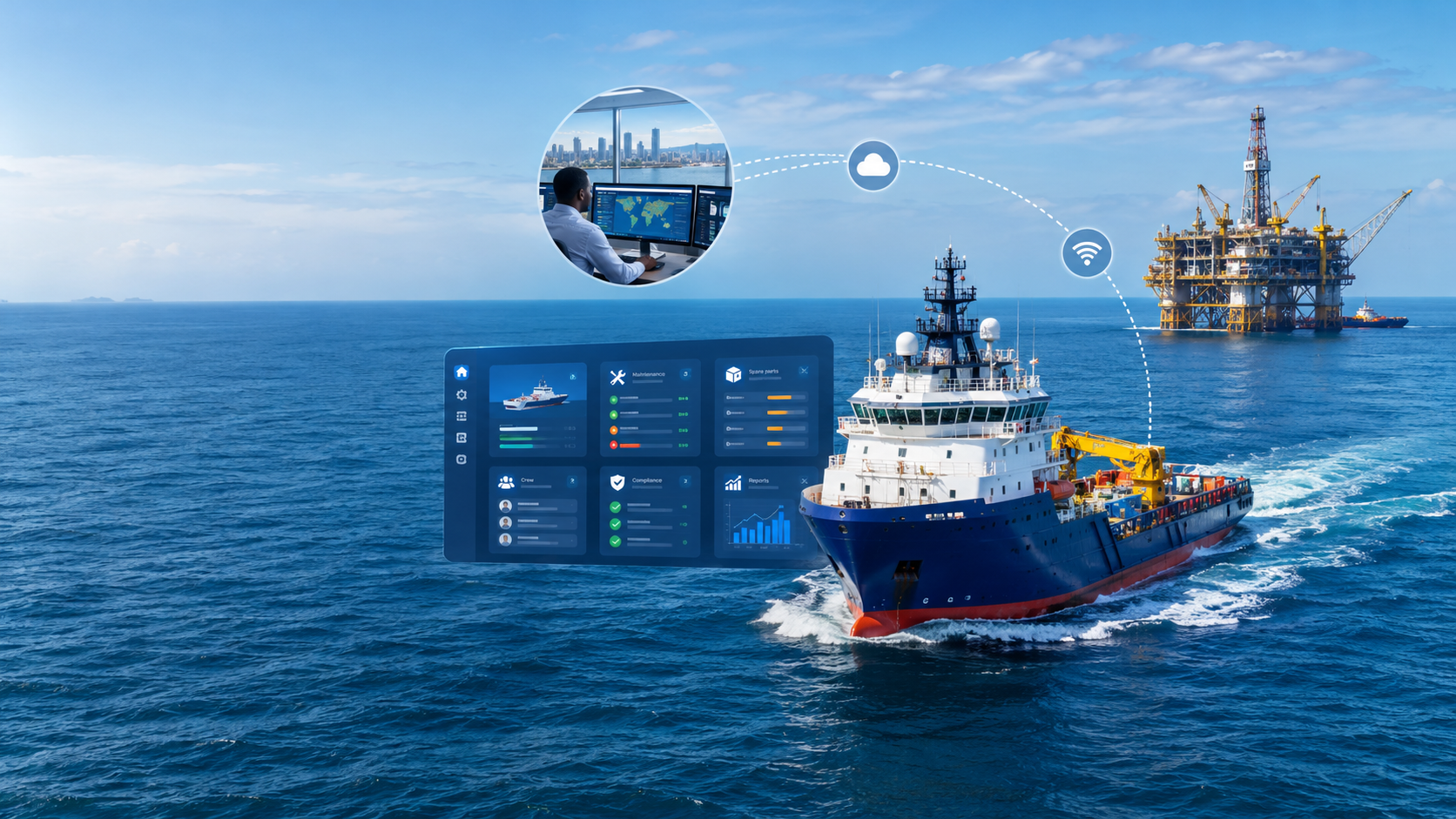
Mercurysoft’s ship management software utilizes an advanced offline-first hybrid synchronization architecture. The vessel software runs on a local onboard database server that requires zero internet connection for daily operations. The Chief Engineer logs running hours, completes work orders, and updates spare parts stock in real-time without latency. The system automatically packages all updates into micro-compressed, encrypted data packets. The moment the vessel detects any internet connection, whether satellite offshore or a coastal MTN/Airtel 4G cellular link upon approaching Lagos or Port Harcourt, it performs a seamless background sync with the shore office server, using minimal bandwidth.
Strategic Comparison: Legacy Spreadsheets vs. Overseas Software vs. Mercurysoft
To understand why forward-thinking Nigerian vessel operators are modernizing their fleets, consider this comprehensive feature and operational comparison:
| Operational Dimension | Manual Excel & WhatsApp | Overseas Enterprise Software | Mercurysoft Marine ERP (Nigeria) |
|---|---|---|---|
| Data Integrity & Audits | Extremely low; easily overwritten or deleted | High; Class approved but complex UI | High; Class compliant, simple intuitive UI |
| NIMASA / NCDMB Compliance | Manual collation; weeks of paperwork | Generic international templates; poor fit | Built-in NCDMB and Cabotage reporting templates |
| Offshore Connectivity | None; files emailed when internet allows | Heavy bandwidth demands; slow sync | Native offline-first; micro-compressed sync packets |
| Currency & Billing | N/A | Expensive USD / Euro annual subscription | Transparent Naira-denominated billing options |
| Technical Support & Training | None | Remote ticketing; expensive foreign fly-in | Local engineers on-site in Lagos & Port Harcourt |
| Implementation Timeline | Zero setup, but permanent operational chaos | 6 to 12 months; high failure rate | 4 to 8 weeks with hands-on database building |
Step-by-Step Implementation Roadmap for Nigerian Fleets
Migrating your fleet from scattered files to an enterprise maritime platform does not have to disrupt active operations. Follow this proven 5-stage deployment methodology:
- Stage 1: Asset Audit & Technical Baseline (Weeks 1–2): Conduct a physical survey of vessel machinery, nameplates, running-hour meters, and shore store inventories in Lagos, Warri, or Port Harcourt.
- Stage 2: Vessel Database Building & Cleansing (Weeks 3–4): Convert physical machinery manuals, shipyard drawings, and spare parts catalogs into structured digital databases coded with standard SFI hierarchies.
- Stage 3: System Configuration & Pilot Deployment (Weeks 5–6): Deploy local server instances on board vessels, configure shore-based cloud dashboards, and establish automated replication protocols.
- Stage 4: Crew & Superintendent Training (Weeks 6–7): Conduct practical, hands-on training for Nigerian Masters, Chief Engineers, and shore superintendents, overcoming traditional software hesitation.
- Stage 5: Fleet-wide Go-Live & Audit Verification (Week 8): Roll out across the remaining vessels, link procurement workflows with local suppliers, and conduct mock NIMASA/OVID audits to confirm readiness.
Conclusion: Future-Proofing Your Fleet for the Next Decade of Shipping
The Nigerian maritime industry is undergoing an unprecedented modernization drive. With stricter enforcement of the Cabotage Act, heightened scrutiny from the NCDMB, and IOC charterers demanding flawless digital compliance, the era of managing multi-million-dollar maritime assets with spreadsheets is coming to an end.
Adopting dedicated maritime fleet management software is not simply an operational upgrade; it is a strategic business decision that defends your profit margins, protects your vessels from regulatory detentions, and positions your company at the top of every major chartering tender in West Africa.
Frequently Asked Questions (FAQ) for Nigerian Ship Operators
Q1: How long does it take to implement fleet management software across our fleet?
A: Implementation time depends on your data readiness. If equipment manuals and spare parts lists are already organized, a vessel can be fully onboarded within 3 to 4 weeks. If paper manuals must be digitized from scratch, Mercurysoft’s database building team handles the heavy lifting, completing a full vessel build in approximately 6 weeks without distracting your superintendents.
Q2: What if our onboard crew has limited computer experience?
A: Yes. Many Nigerian seafarers are experienced mariners who prefer simple, practical workflows over complicated enterprise software. Mercurysoft features a clean, highly visual interface with step-by-step job cards, photo-upload capabilities, and localized training conducted by engineers in Lagos and Port Harcourt who speak the language of Nigerian sea staff.
Q3: Can Mercurysoft integrate with our shore-based accounting software in Lagos?
A: Yes. Mercurysoft provides direct export and synchronization capabilities with leading accounting packages including QuickBooks, Sage, Microsoft Dynamics, SAP, and custom Nigerian payroll systems, ensuring seamless three-way purchase order and invoice reconciliation.
Schedule Your Fleet Consultation with Mercurysoft
Ready to transform your technical operations, achieve 100% NIMASA and NCDMB audit readiness, and eliminate operational blind spots across your fleet? Contact Mercurysoft’s marine technology specialists in Lagos today. Book a free technical demonstration and discover how our locally supported, offline-first marine ERP gives your fleet an unbeatable competitive edge.